

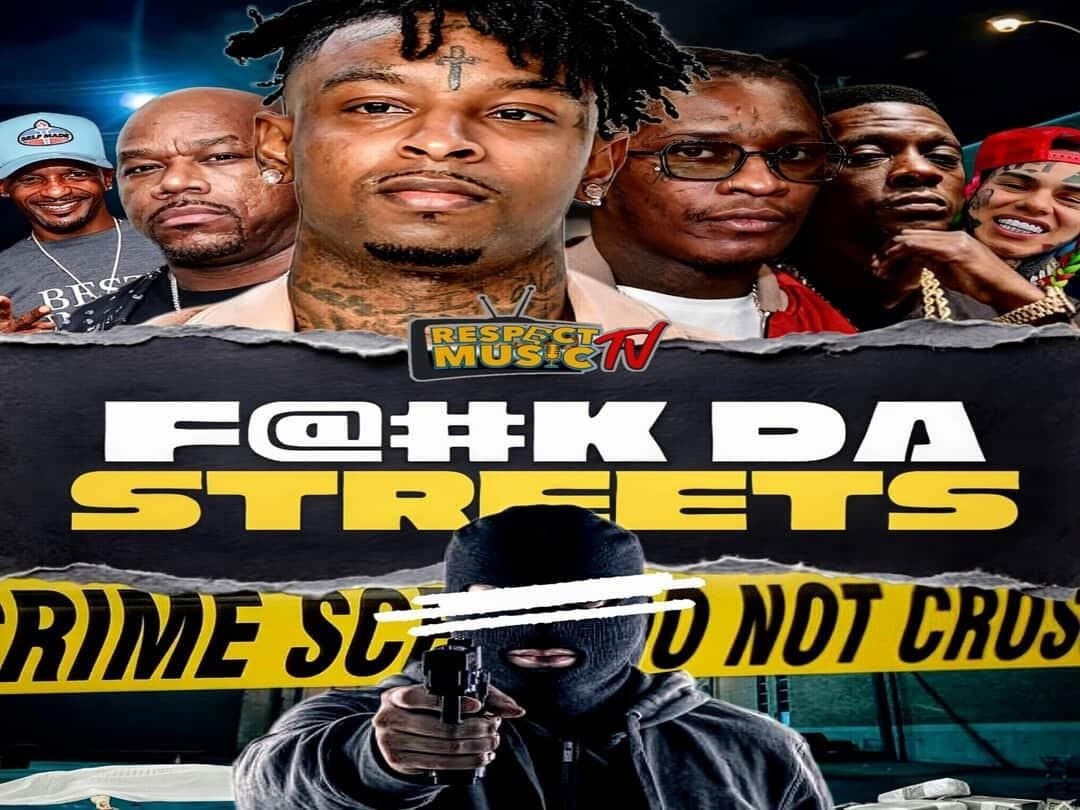
“Fuck Da Streets”: Cultural Identity, Street Legitimacy, and the Crisis of Authenticity in Contemporary Hip-Hop
Introduction
In recent weeks, the phrase “Fuck Da Streets” has gained traction across social media platforms, igniting widespread debate within hip-hop culture and beyond. Artists, industry representatives, street-affiliated individuals, and media personalities have weighed in, producing a multifaceted discourse that reflects deeper tensions surrounding authenticity, loyalty, survival, and cultural identity. This article examines the origins of the movement, the polarized responses it has generated, and the broader implications it reveals about street legitimacy, hip-hop’s evolving audience, and the contradictions embedded within contemporary street culture.
Origins of the Movement
The movement began when Atlanta rapper 21 Savage publicly posted “Fuck Da Streets” on X (formerly Twitter). The statement was immediately amplified by several prominent figures in hip-hop, including Young Thug, G Herbo, and YFN Lucci, while others such as Lil Boosie, Ralo, and HoneyKomb Brazy expressed strong opposition. The phrase’s ambiguity invited interpretation, leading to intense debate over whether it signified abandonment of street values or a critique of the systemic harm associated with street life.
During a live Instagram session, 21 Savage later clarified that his statement may have been poorly articulated and suggested “Save the Streets” as a more accurate expression of his intent. This clarification, however, did little to quell controversy. Instead, it raised questions about perceived goalpost shifting, particularly given ongoing conversations about cooperation with law enforcement among Atlanta rappers.
Street Codes, Authenticity, and Selective Morality
Central to the controversy is the role of street code, unwritten rules governing loyalty, silence, and authenticity. Historically, these codes have demanded that individuals accept severe legal consequences rather than cooperate with authorities. However, as this article argues, such codes are neither uniformly enforced nor consistently upheld.
The cases of Young Thug and Gunna exemplify this contradiction. Young Thug, long regarded as an authentic street figure, has faced renewed scrutiny following the release of an interrogation video that challenged perceptions of his adherence to street codes. The resulting erosion of his street credibility appears to have influenced both public perception and commercial performance.
Gunna, conversely, has experienced continued commercial success following his release from jail after entering an Alford plea. His chart performance suggests a significant cultural shift: hip-hop’s audience has expanded globally, diminishing the authority of street-based moral judgments. For many listeners outside the United States or outside street culture altogether, legal cooperation is irrelevant to musical quality or artistic value.
The Globalization of Hip-Hop and the Decline of Street Authority
Hip-hop is no longer a subculture governed primarily by inner-city norms. Its global expansion has fundamentally altered its moral economy. Audiences in suburban America, Europe, Africa, and Australia often engage with hip-hop divorced from the social realities that produced it. As a result, street legitimacy no longer functions as the gatekeeping mechanism it once did.
This shift explains why Gunna’s career has flourished despite accusations that would have ended artists’ careers in previous decades. It also underscores a broader truth: the authority of “the streets” has diminished, even as its imagery continues to be commodified.
Identity, Nostalgia, and Emotional Attachment to the Streets
Resistance to the “Fuck Da Streets” movement often stems from emotional attachment rather than ideological disagreement. Many individuals raised in impoverished environments feel indebted to the streets for shaping their resilience and identity. Memories of hardship such as food insecurity and housing instability create a sense of loyalty that persists even after material success.
However, this attachment raises critical questions: Why is street identity treated as an exclusive marker of authenticity? Why is pride in survival conflated with pride in the conditions that necessitated survival?
The insistence on preserving street identity may reflect what psychologists describe as trauma bonding, wherein individuals form emotional attachments to environments or systems that cause harm.
Media Discourse and Gatekeeping of Street Narratives
Public debates involving figures such as Wack 100 and Charleston White further illustrate how street narratives are policed. Wack 100’s insistence that only those with street credentials may critique street culture exemplifies exclusionary gatekeeping that suppresses reform-oriented discourse.
Charleston White, a polarizing but consistent critic of street culture, offers a counter-narrative. Having openly cooperated with law enforcement as a youth, White rejects street legitimacy altogether and frames survival, not loyalty, as the highest moral priority. His work with youth outreach programs underscores an alternative vision rooted in prevention rather than glorification.
Industry Incentives and the Commodification of Trauma
The music industry plays a significant role in sustaining street mythology. By monetizing narratives of violence, struggle, and criminality, it transforms trauma into spectacle. Young listeners, observing the rewards afforded to artists who embody street personas, may conclude that deeper immersion in street life is a prerequisite for success.
Tragically, many never survive long enough to escape. Others who do escape continue perpetuating harmful narratives, reinforcing the cycle for the next generation.
Historical Context and Cultural Misattribution
The streets did not emerge in isolation. Structural forces, slavery, segregation, redlining, mass incarceration, and economic disenfranchisement produced the conditions now romanticized in popular culture. Black communities have historically demonstrated intellectual, artistic, and technological excellence long before the creation of urban ghettos.
Hip-hop itself originated as a form of resistance and cultural education, aligned with the ethos of the Civil Rights Movement. Its early emphasis on self-knowledge, community uplift, and political consciousness was later overshadowed by commercially incentivized gangsta narratives.
Psychological Dimensions: Dopamine, Consumption, and Resistance to Change
Contemporary audiences’ preference for aggressive or “low-vibration” music can be partially explained through neuroscience. Dopamine-driven reward systems reinforce familiar stimuli, making cultural change psychologically uncomfortable. As with any form of overstimulation, recalibration requires intentional disengagement and time.
This biological reality complicates efforts to shift hip-hop’s dominant narratives, as both artists and audiences may resist content that challenges existing habits or demands introspection.
Conclusion
The “Fuck Da Streets” movement is not a rejection of community or cultural origin; it is a critique of systems that exploit loyalty, normalize disposability, and conflate survival with virtue. Street identity, when unexamined, becomes a mechanism of control rather than empowerment.
Recognizing this does not negate resilience, it contextualizes it. Greatness does not emerge from deprivation; it persists despite it. Until this distinction is widely acknowledged, hip-hop culture will continue to wrestle with the same contradictions.
Rejecting destructive systems is not betrayal. It is evolution.
https://www.instagram.com/reel/DSqHCdQEZtz/?igsh=NTc4MTIwNjQ2YQ==
Fuck Da Streets.
Justin C. Hamby
@deycallmesoul